
Festival Internacional de Benicàssim
At most festivals the music stops when the sky lightens. At Benicàssim it barely pauses. Since its founding, the Festival Internacional de Benicàssim has run its stages deep into the small hours, with sets scheduled from around five in the evening to eight the following morning. Headliners here have gone on closer to dawn than to dinner, playing to crowds who have made peace with sleeping through the Mediterranean afternoon. It is a festival built around a simple, slightly reckless idea: that the best hours for a concert are the ones after midnight.
The All-Night Bargain
The nocturnal timetable is the festival's signature and its logic. Playing through the cool of the night spares tens of thousands of people the brutal July sun of the Valencian coast, and it turns the beach town into a place that lives on inverted time, quiet by day, roaring by night. The main stages, Las Palmas, Visa and South Beach Dance, hold roughly thirty thousand, fifteen thousand and eight thousand people, so a single night can pack a small city's worth of listeners onto the sand. The camping grounds open days early, and multi-day ticket holders can pitch a tent for the better part of a week, treating the whole thing less as a concert than as a temporary town.
A Guest List to Envy
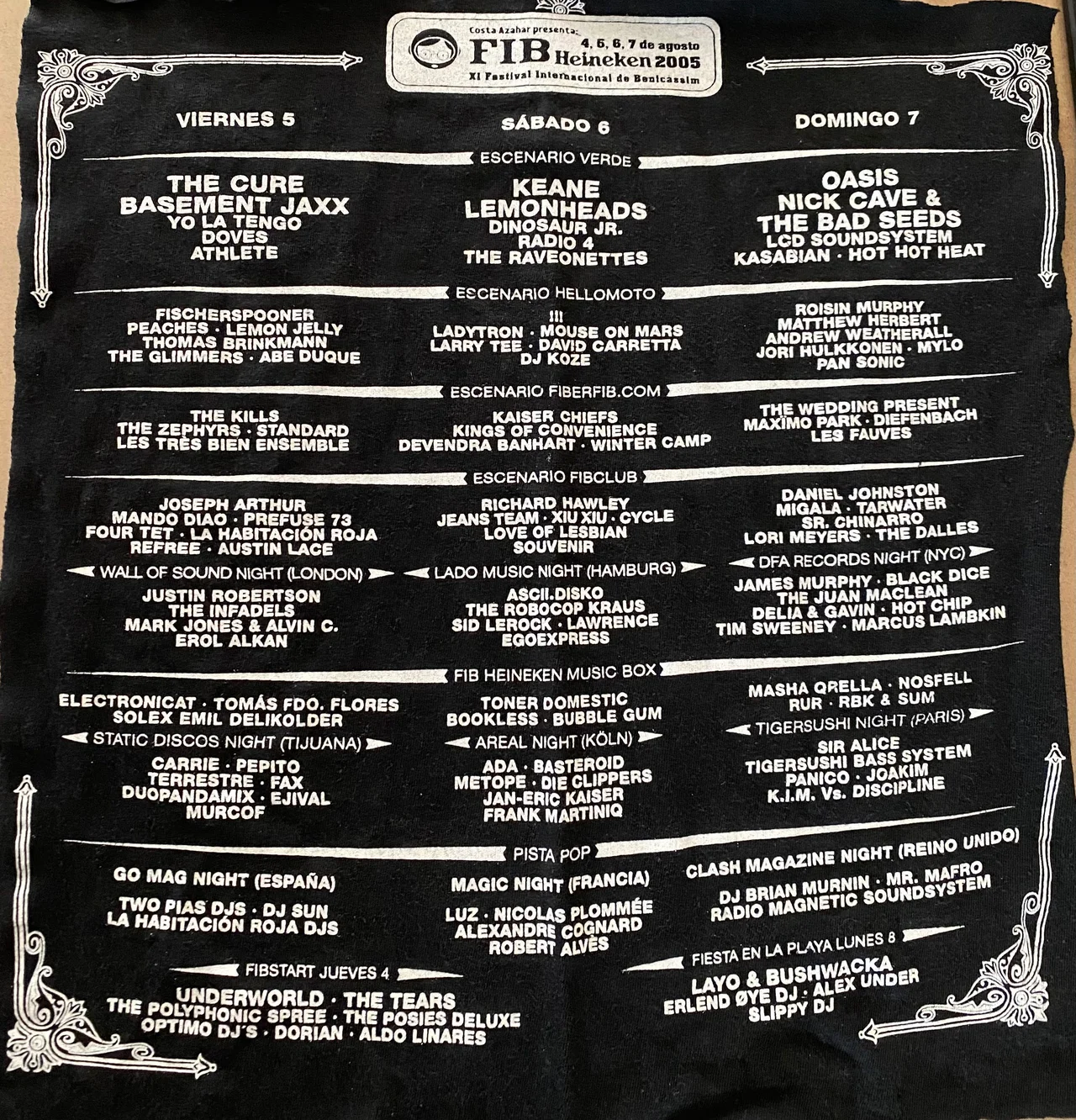
For a festival that began in 1995, Benicàssim built an extraordinary roster with surprising speed. Over the years its stages have hosted Radiohead, Blur, Oasis, The Strokes, The Killers, Arctic Monkeys, Depeche Mode, Kraftwerk, The Chemical Brothers and Morrissey, alongside older statesmen like Lou Reed, Paul Weller and Brian Wilson. The programming has always leaned toward British indie and electronic music, which drew waves of visitors from the United Kingdom and gave the festival a reputation as a kind of Mediterranean outpost of the British music press. Attendance grew to match the lineups: capacity passed fifty thousand in 2009, and in 2020 more than a hundred and fifty thousand people were reported across the run.
More Than the Music
FIB was never billed purely as a rock festival. From early on its programme reached beyond the stages to take in short films, fashion shows and art, positioning the event as a broad cultural gathering rather than a simple concert series. Its success bred offshoots, among them Saturday Night Fiber, a spin-off launched in 2008 that carried the Benicàssim brand up to Madrid for a single night. Around the core festival grew the familiar machinery of a modern music event: camping villages, transport links and accommodation packages built to move tens of thousands of people to a small coastal town and keep them fed, housed and entertained for the better part of a week. For a place of Benicàssim's size, staging all of that every July is no small feat of organisation, and it has made the festival as much a part of the town's identity as the beach itself.
The Night the Wind Came
Not every year went to plan. During the 2009 festival, high winds fed a fire and made conditions on several stages unsafe, forcing the cancellation of a string of acts, Kings of Leon among them, who were unable to perform. Several hundred campers had to be evacuated from the site to a nearby sports hall while the weather passed. The festival resumed the following day with limited disruption, the sort of improvised recovery that large open-air events learn to manage. For a festival that stakes everything on the outdoors and the night, the episode was a reminder of how much depends on the coast staying calm.
Music and Its Politics
Benicàssim has not been free of argument. Critics from Valencian cultural circles have long complained that a festival held in the Valencian Community, and supported by public money, does little to promote the region's own language and artists. The debate sharpened when a former director stated that he did not intend to book bands singing in Catalan, Basque or Galician, drawing criticism from local politicians and cultural associations. It is a familiar tension in a place whose identity is tied to a language distinct from Castilian Spanish: whether a festival that sells the region to the world also owes something to the culture on whose beaches it stands.
From the Air
The festival grounds sit at the southern edge of Benicàssim, near 40.047°N, 0.069°E, a short way inland from the beach on the Costa del Azahar. During its July run the site is unmistakable from the air at night: a cluster of stage lighting and camping fields glowing against an otherwise dark coastline, with the dark bulk of the Desert de les Palmes range behind. Castellón-Costa Azahar (LECN) lies just south; Valencia (LEVC) is down the coast to the southwest and Reus (LERS) up the coast to the northeast. Expect warm, hazy, generally calm summer conditions, though the 2009 fire is a reminder that coastal winds can rise quickly.
Nearby Stories
- Alcalà de Xivert 7 km away
- Llíria 24 km away
- Vía Verde de Ojos Negros 31 km away
- Battle of Saguntum 38 km away
- Delta de l'Ebre Natural Park 49 km away
- Teruel 62 km away
- Battle of Ebro River 82 km away
- Illa Conillera 94 km away