
Desert de les Palmes Natural Park
There is no sand here, and the palms are barely knee-high. The name Desert de les Palmes puzzles nearly everyone who climbs into these green Castellón mountains for the first time, expecting dunes and finding instead pine-clad ridges, rocky outcrops and long views over the Mediterranean. The word desert is not a description of the landscape at all. It was borrowed from the Carmelite friars who once retreated here, and in their vocabulary a desert was not a place of sand but a place of silence, chosen for being far from the noise of the world.
The Monks' Vocabulary
The Carmelites were a mendicant order given to contemplation, and they called their sites of spiritual retreat santos desiertos, holy deserts, whether or not a grain of sand was in sight. What they wanted was solitude, and these mountains behind the coast gave it to them. The ruins of their monastery still stand within the park, a reminder that the name records a state of mind rather than a climate. The second half of the name is more literal. It comes from the abundance of a low fan palm, Chamaerops humilis, the only palm native to mainland Europe, which grows across these slopes in dense, spiky clumps.
A Landscape That Burns and Returns
Fire has shaped this park as much as prayer. The reserve covers about 3,293 hectares, and much of it burned repeatedly during the 1980s and early 1990s, which is why there is little old-growth forest left on these ridges. What grows now is younger, tougher, the resilient scrub of a Mediterranean mountainside that has learned to recover from flame. It is a familiar cycle along this coast, where summer heat and dry vegetation make wildfire a recurring visitor, and where the land answers each burn by greening again from the roots.
A Balcony Over the Sea
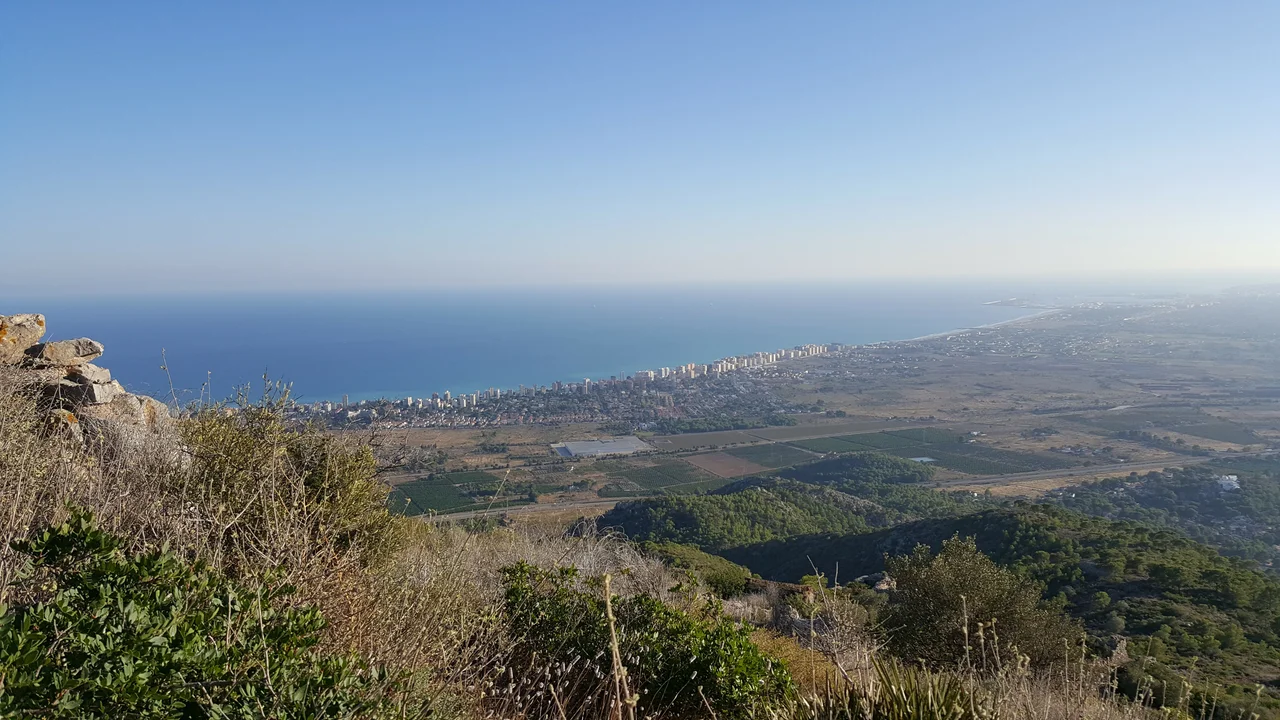
For all its scars, the Desert de les Palmes is prized above all for its views. From the higher rock formations, hikers look down on Benicàssim and the broad blue plate of the Mediterranean, the coast unrolling in both directions. The park's steep, slanting outcrops have become a favourite destination for walkers who come as much for the vantage as for the trails, standing on tilted slabs of stone with the whole shoreline laid out below. The same ridge that shelters the beach towns from the north wind gives, from its crest, one of the finest coastal panoramas in the region.
The Park and Its Towns
The Valencian government declared the Desert de les Palmes a protected reserve in 1989, drawing a boundary around mountains that touch five municipalities, Benicàssim, Borriol, Cabanes, Castellón de la Plana and La Pobla Tornesa. That makes the park a shared green heart for a cluster of Castellón towns, an upland commons rising just behind a densely used coast. In a stretch of shoreline given over largely to tourism, it preserves a wilder counterweight: a mountain named for silence, covered in the only palm mainland Europe can call its own.
The Cloister and the Trail
The park's human centrepiece is the ruin of the Carmelite monastery, the holy desert that gave these mountains their strange name. Built as a retreat where friars could live apart from the world, it now stands roofless among the pines, its walls slowly returning to the hillside, a quiet emblem of the solitude the order came here to find. That contemplative past sits easily alongside the park's life today as a walkers' destination. Trails climb from the wooded lower slopes to the bare rock at the top, winding past the ruins toward the tilted outcrops that draw hikers for the view. The paths are not gentle everywhere, and the reward for the steeper stretches is that balcony over Benicàssim and the Mediterranean. In a single afternoon a visitor can move from shaded forest to exposed summit, from the hush of a ruined cloister to a wind-scoured ridge, tracing in a few hours the same landscape that once drew monks seeking silence and now draws city-dwellers seeking air, quiet and a wide horizon.
From the Air
The Desert de les Palmes occupies the coastal range at roughly 40.084°N, 0.041°E, immediately inland from Benicàssim in the province of Castellón. From the air it is easy to identify: an abrupt green-and-grey massif standing between the built-up coastal strip and the flatter interior plain, with the Mediterranean on its eastern side. Its ridgeline is the dominant terrain feature for local low-level navigation and a clear divider between shore and hinterland. Castellón-Costa Azahar (LECN) lies just southeast toward the coast; Valencia (LEVC) is down the coast to the southwest and Reus (LERS) to the northeast. Note rising terrain and the potential for summer wildfire smoke; clear days reveal the monastery ruins and rock outcrops on the higher slopes.
Nearby Stories
- Sant Mateu 3.9 km away
- Serra Calderona 23 km away
- Delta de l'Ebre Natural Park 30 km away
- Vía Verde de Ojos Negros 35 km away
- La Vall d'Uixó 36 km away
- Battle of Ebro River 63 km away
- Battle of Belchite (1937) 102 km away
- Cala d'Albarca 110 km away