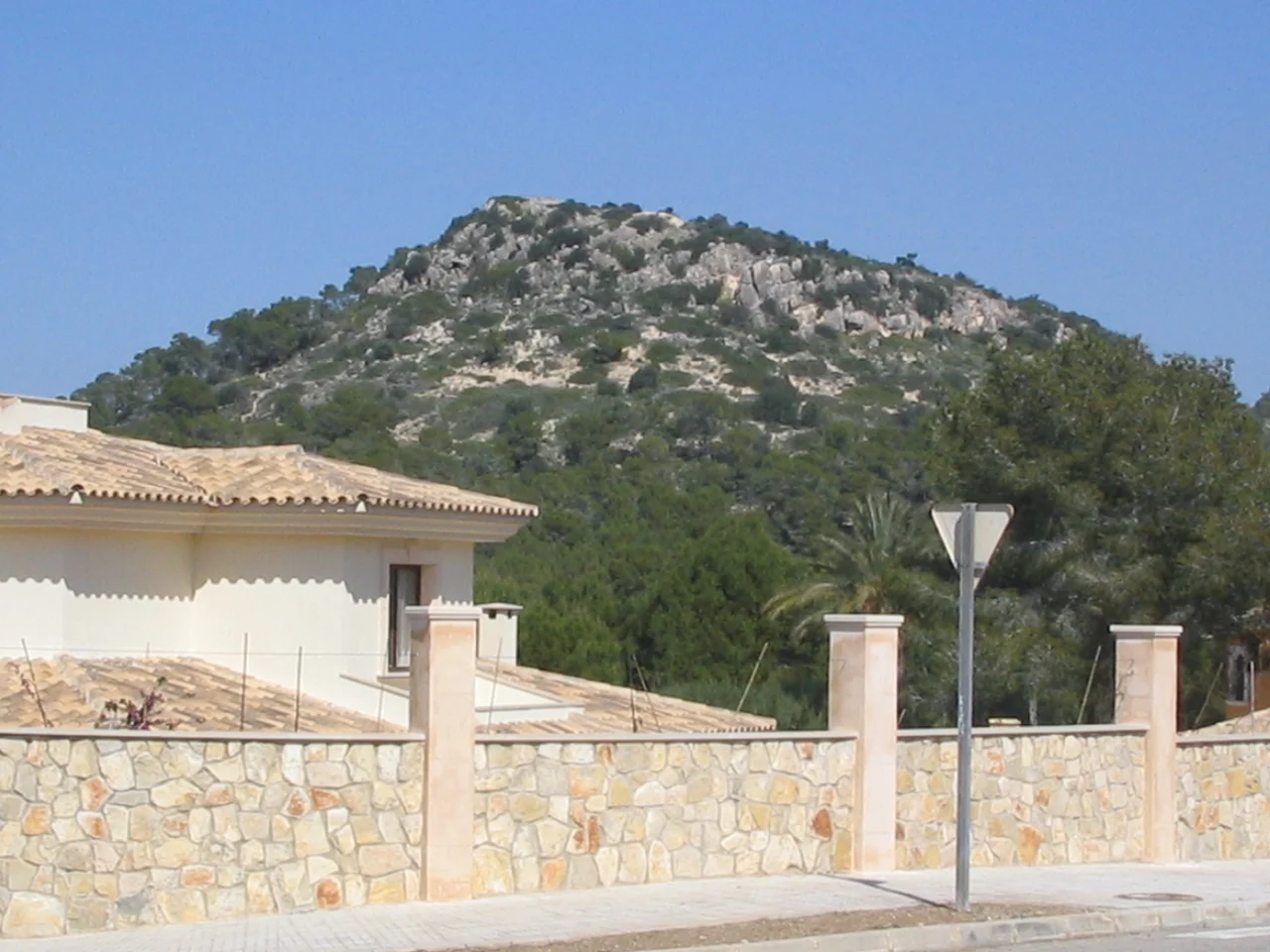

Puig de sa Morisca Archaeological Park
For three thousand years, this hill has been in the business of watching. Puig de sa Morisca — 'Moorish Peak' — rises above the bay of Santa Ponsa on Mallorca's southwest coast, and from its summit the eye can follow every ship that approaches the shore. The people of the Late Bronze Age understood the advantage. Somewhere around 1300 BC they climbed this modest peak and made it a lookout over the sea lanes, and the watch they began never really ended: the same commanding view served sentries and coast-watchers right up into modern times. Today the hill is a 35-hectare archaeological park, its long vigil preserved for anyone willing to make the climb.
The Tower on the Summit
Climb to the top and you reach the oldest layer of the story: the remains of a circular talayot, a stone tower some nine metres across, its walls thickening exactly where the slope offered an enemy the easiest way up. Talayots are the signature monuments of Mallorca's prehistoric Talayotic culture, and this one crowned a settlement that grew around it. The first watchers arrived in the Late Bronze Age; from about the sixth century BC, the community raised a cluster of stone towers across the summit, each positioned to extend the field of view a little further along the coast. It was less a fortress than an early information network — a set of eyes trained permanently on the water, ready to mark the arrival of anyone by sea. Standing among the tumbled stones, you can still trace how the towers spoke to one another across the ridge.
Reading the Dead at Son Ferrer
Not everything on the hill was built to look outward. Among the park's monuments is the burial mound at Son Ferrer, a funerary structure that drew archaeologists for the better part of a decade. Between 2000 and 2009, teams from the University of the Balearic Islands, the University of Barcelona, and the University of Valencia excavated it together, patiently lifting layer after layer to understand how the ancient community treated its dead. Such joint digs are how a place like this gives up its secrets — slowly, and through the combined effort of specialists who may spend years on a single site. The tomb anchors the human side of the hill: not only who watched the sea, but who was mourned here when the watching was done.
A Hill of Many Watches
The peak has been preserved as a park since 2002, and within its bounds lie more than fifteen distinct sites and nine structures of particular ethnological interest — a density of remains that records not one era but many. Even the name carries a later chapter. 'Sa Morisca,' the Moorish Peak, points to the centuries when this same summit served as a coastal watch against raiders from the sea, long after its Bronze Age founders were gone. The hill was simply too useful a vantage point to abandon. Each culture that held this coast climbed it for the same reason, and left its mark before moving on. The layers overlap rather than replace one another, so that a single climb crosses three thousand years of the same instinct — to hold the high ground and watch the horizon.
The Living Park
There is a botanical dimension too. The park has been planted as a living catalogue of the region's plants, gathering the Balearic flora that grows within a ten-kilometre radius so that visitors can walk among the same trees and shrubs that clothed the hill in antiquity. The result is a place that rewards more than one kind of curiosity. Archaeologists come for the towers and the tombs; walkers come for the views over the bay of Santa Ponsa and the greenery underfoot. It is a rare site where three thousand years of history and a hillside of native plants share the same short trail. From the summit, the coast spreads out exactly as it did for the first watchers — the ships are pleasure boats now, but the vantage is unchanged.
From the Air
Puig de sa Morisca rises at 39.509°N, 2.483°E, a low hill immediately inland of the bay of Santa Ponsa in the municipality of Calvià. From Palma de Mallorca (LEPA), about 22 km to the east, track west-southwest along the coast. The best visual references are the bay of Santa Ponsa with its marina and the cross marking King James I's landing, just south of the hill, and the broader Serra de Tramuntana rising behind it to the north. A viewing altitude of 2,500-4,000 ft AGL shows why the summit commanded such a wide field of view over the sea lanes. Coastal visibility is typically good; watch for glare when the low sun is on the water.
Nearby Stories
- Deia 2.4 km away
- Manacor 13 km away
- Fundacion Yannick y Ben Jakober 13 km away
- Illa de Tagomago 44 km away
- Cala de Sant Vicent 62 km away
- S'Argamassa Roman Fish Farm 95 km away
- Illa Grossa 123 km away
- Shipwreck of Dellys 262 km away