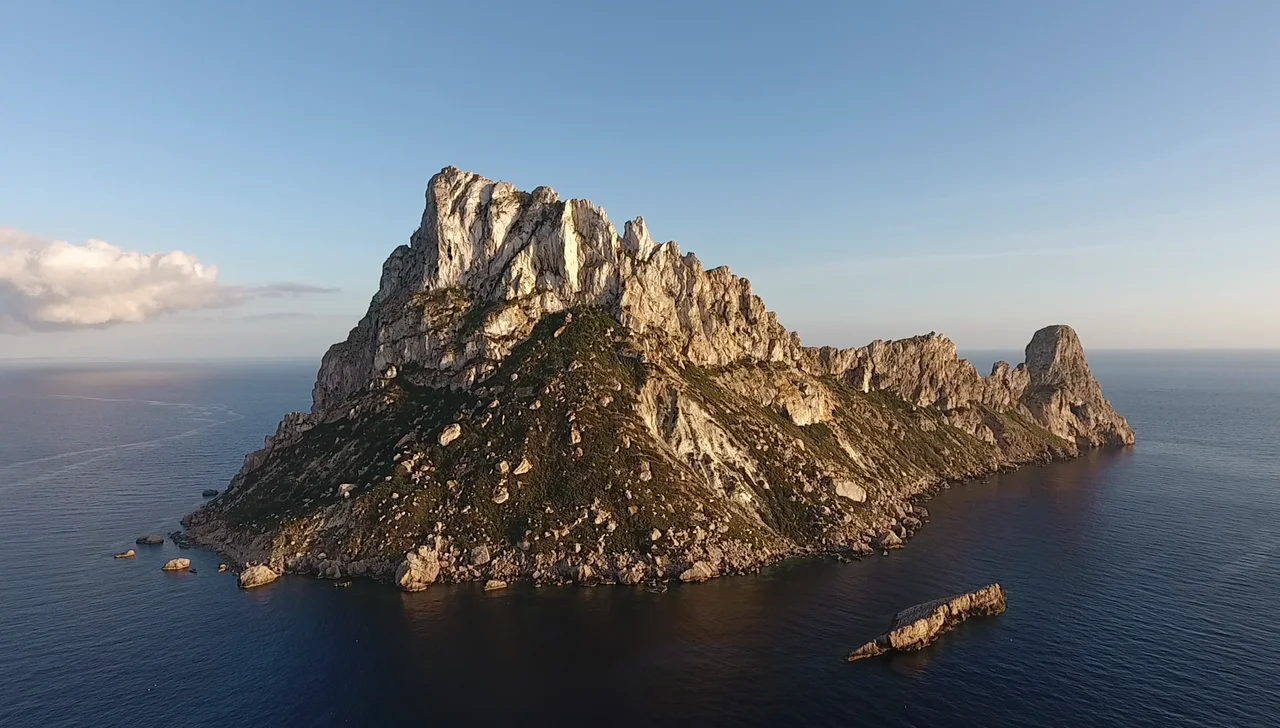

Es Vedrà
Sailors swear their compasses spin near Es Vedrà. Believers rank it among the most magnetic places on Earth, alongside the Pyramids and the Bermuda Triangle. Geologists have a duller answer: the island is a 413-metre wedge of Mesozoic limestone, and it holds no magnetic metal to spin anything at all. And yet the myths keep coming. This uninhabited spike of pale rock, standing a mile and a half off the west coast of Ibiza, has drawn sirens, goddesses, hermits, novelists and DJs into its orbit — proof that a place does not need magnetism to be magnetic.
Just Limestone
Strip away the stories and Es Vedrà is a geological fact: a steep, uninhabited island of Mesozoic limestone rising 413 metres straight out of the sea, about a mile and a half off the shore at Cala d'Hort. It belongs to the municipality of Sant Josep de sa Talaia and forms part of the protected Cala d'Hort nature reserve. The famous magnetism is fiction — the rock holds no metal to bend a compass needle — but it is easy to see how the legend took root. Few landforms anywhere look so deliberate, so much like something raised on purpose, as this pale triangle standing alone on the water.
The Island of the Sirens
The oldest stories reach back to myth. Es Vedrà has long been named as the island of the Sirens — the creatures whose song tried to lure Odysseus to his death in Homer's Odyssey — and sailors passing beneath its cliffs have imagined that voice on the wind for centuries. Older still is its link to Tanit, the Phoenician moon goddess who became the great deity of ancient Ibiza. Legend holds that offerings were once made to her on the island's shores by the light of the full moon. Whether or not anyone truly worshipped here, the association fits: a place this strange seems to demand a goddess.
The Friar Who Saw Visions
In the second half of the 19th century, the island drew a very real hermit. Francisco Palau, a Discalced Carmelite friar sent into exile in these islands, spent time in retreat on Es Vedrà, and what he recorded there has coloured its reputation ever since. In his writings he described visions and supernatural experiences of every kind — a man alone on a rock in the sea, convinced he was in the company of the divine. It is impossible to know now what Palau saw. But his testimony gave the island something its later, flashier legends lack: a witness who staked his own faith on the place.
A Rock for Falcons and Lizards
For all its mystique, Es Vedrà is also simply wild habitat. Eleonora's falcon, a slender, long-winged bird of prey, hunts and nests along its cliffs, riding the updrafts off the sheer stone. The island shelters the Ibizan wall lizard as well, a species that has split into distinct races across these isolated islets — small reptiles evolving in their own directions on rock no human keeps. Protected as part of the Cala d'Hort reserve, the island is left largely to them: falcons above, lizards below, and the sea working endlessly at the base of the cliffs.
The Modern Myth Machine
The legends never stopped — they simply changed medium. Es Vedrà has become a fixture of Ibiza's cultural imagination, its silhouette lent to art and music again and again. The trance artists Aly & Fila, with The Thrillseekers, named a track after it in 2015, and Armin van Buuren released his own 'Es Vedra' in 2024. That same year the rock featured in the Ibiza-set season of the reality series Below Deck Sailing Yacht and stood at the mystical heart of Matt Haig's novel The Life Impossible, in which Es Vedrà is a place worth protecting. Centuries after the sirens, the island is still casting its spell — now on prime time and the pop charts.
From the Air
Es Vedrà rises at 38.87°N, 1.20°E, just off Ibiza's southwest coast at Cala d'Hort. The island is its own landmark: a solitary 413-metre triangular rock, one of the most recognisable natural features in the western Mediterranean and visible from far out to sea. Circle it at 1,500–4,000 ft to appreciate the pyramid profile; the west face is best lit in the afternoon and at sunset. Expect strong updrafts and turbulence off the cliffs, and give the rock room. Ibiza Airport (LEIB) lies about 18 km to the east on the island's southern plain.
Nearby Stories
- Cape Sant Antoni, Spain 46 km away
- Penyal d'Ifac Natural Park 55 km away
- Andratx 71 km away
- Illa Grossa 78 km away
- Puig de sa Morisca Archaeological Park 89 km away
- Calpe 103 km away
- Santa Ponsa 113 km away
- Battle of Cape Cherchell 200 km away