
Battle of Alcalá (1129)
The army came from deep in Morocco with a single quarry in mind: one king. In 1129 the Almoravids gathered a fresh force from North Africa, joined it with the horsemen of the governor of Seville, and pointed the whole of it at Alfonso I of Aragon, the ruler whose relentless campaigning had earned him the name el Batallador, the Battler. They meant to hunt him down. Instead, at a castle in the hills near the Valencian coast, it was the Almoravids who were beaten, and the defeat helped begin the unraveling of their empire in the east.
The King They Called the Battler
Alfonso I of Aragon did not earn his nickname by sitting still. As the Almoravid empire, the Berber power that had swept up from North Africa to dominate Muslim Iberia, fell into decline almost as fast as it had risen, Alfonso pressed his advantage hard. He took Zaragoza in 1118, then Calatayud and Daroca by 1120, pushing the frontier of the Christian kingdoms deep into contested ground. He was a king who understood that a weakening enemy was an opportunity, and he spent his reign turning that understanding into conquest after conquest across the valley of the Ebro and beyond.
Who the Almoravids Were
The empire Alfonso faced had itself been an outsider once. The Almoravids were a Berber movement that had swept north out of the Sahara and Morocco decades earlier to unite Muslim Iberia under a single banner, halting the Christian advance for a time and ruling their vast realm from Marrakesh. But a power built on rapid conquest can unravel just as fast as it rose. By the 1120s the Almoravids were loosening their grip on the distant Iberian provinces they had gathered, strained by the sheer reach of what they held. It was into that weakening that Alfonso drove his campaigns, reading the decline correctly and pressing on it without mercy. The army sent to hunt him in 1129 was, in a sense, an attempt to prove the empire still had teeth.
An Army Sent to Hunt a King
In 1128 Alfonso carried the war into the land of Valencia itself, striking into the heart of Almoravid territory in the east, the region Muslim geographers called Xarq al-Andalus. This time the Almoravids answered in force. They summoned a powerful army newly arrived from deep in Morocco and merged it with the African cavalry of the governor of Seville, assembling the combined host for the express purpose of running down the Aragonese king who had troubled them for so long. It was less a defense of a border than a manhunt on the scale of an army, aimed at ending Alfonso and his ambitions in a single campaign.
The Castle of the Alcalans
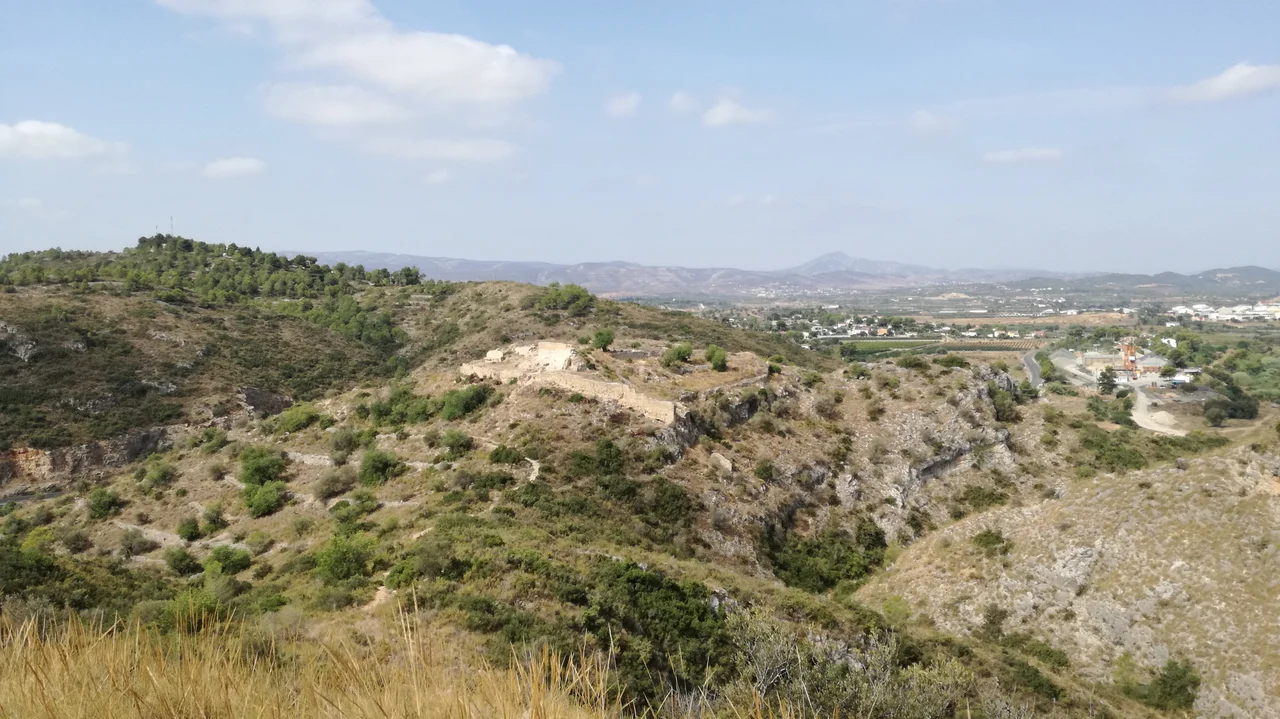
The two forces met at the Castle of els Alcalans, a stronghold in the hills of the interior near the modern town of Montserrat, southwest of the city of Valencia. The clash is remembered by two names, the Battle of Alcala and the Battle of Cullera, tying it to the coastal country that stretches toward the mouth of the Xuquer. When it ended, the hunters had become the hunted: the Aragonese carried the day, and the army sent to destroy Alfonso was itself broken on the Valencian hillside. The Battler had turned the trap against those who set it. For Alfonso, it was one more vindication of a career spent betting against a fading power.
The Crack That Widened
The consequences outran the battlefield. The Valencian Muslim chronicler Ibn al-Abbar, looking back on the event, judged that the Almoravids' disastrous defeat cost them their standing in Xarq al-Andalus. Their authority, once feared, began to lose its grip on the people it ruled. In time that erosion helped open the way for a second age of taifa kingdoms, the small independent Muslim states that fractured the region from the 1140s, reaching Valencia around 1145. A single lost battle at an obscure hilltop castle did not topple an empire on its own, but it exposed how brittle Almoravid power had become, and the cracks it revealed only widened from there.
From the Air
The Castle of els Alcalans stands near 39.3583 N, 0.6039 W in the hills near Montserrat, in the interior of the province of Valencia southwest of the city. From the air the site reads as a ruined hilltop fortification commanding the surrounding valleys, set in dry inland country of low ranges, pine, and scattered agriculture away from the coastal plain. Best viewed at 2,000 to 4,000 feet in clear conditions; the elevated position that made it defensible also makes it a useful visual reference among the folds of the terrain. Valencia (LEVC) is the nearest major airport, roughly 30 to 35 km northeast; Alicante-Elche (LEAL) lies farther south. Clear morning light before inland heat haze builds gives the sharpest view of the ridgelines and the castle remains.
Nearby Stories
- Bombing of Xàtiva 3.5 km away
- Llíria 10 km away
- Battle of Almansa 17 km away
- Kelin 20 km away
- Hēmeroskopeion 22 km away
- Requena 23 km away
- Dénia 51 km away
- Festival Internacional de Benicàssim 56 km away