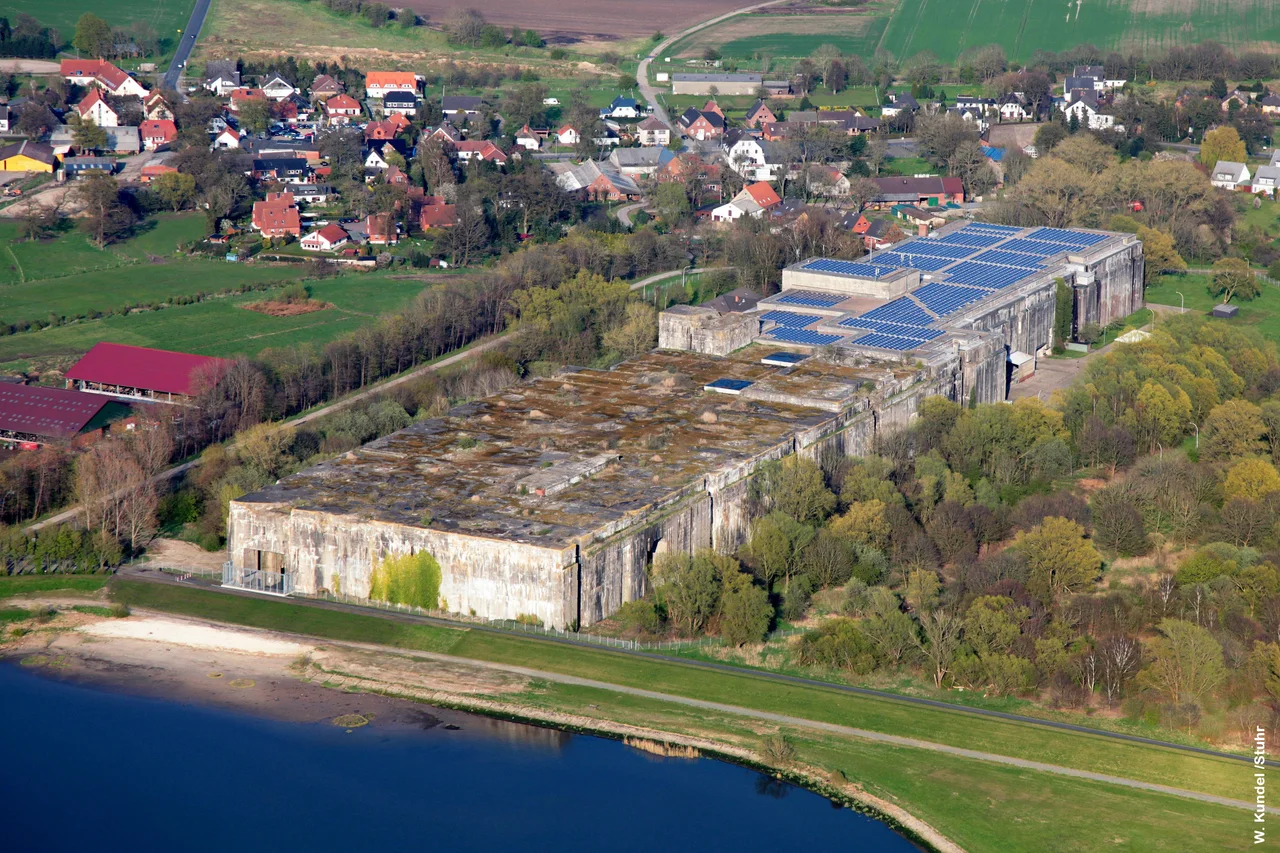

Valentin submarine pens
Around 1,600 forced labourers died building it. Of those, 1,144 are known by name. Start there, because the concrete will otherwise take over the story - and the concrete is genuinely difficult to ignore. On the Weser between the Bremen suburbs of Rekum and Farge stands a slab 426 metres long and 97 metres wide, its walls four and a half metres thick, its roof reaching seven metres in the eastern section. The Germans codenamed it Valentin and intended it to assemble Type XXI U-boats from prefabricated sections floated upriver on barges: three boats in April 1945, then at least fourteen every month. By March 1945 it was ninety percent finished and the machine tools were installed. Not one submarine was ever completed inside it. Everything it cost was paid by people who had no say in the matter, and it bought nothing at all.
The People Who Built It
Up to 10,000 people worked the site at a time, and estimates of the total run to 12,000. They were civilian forced labourers seized from eastern and western Europe, Soviet prisoners of war, Italian military internees, concentration camp prisoners held at the Neuengamme satellite camp at Bremen-Farge, and men sent from the Bremen Gestapo's so-called labour re-education camps. They lived in camps scattered within about six kilometres of the building site. Some were housed inside an empty underground fuel tank at the naval oil depot next door - a steel chamber with no daylight, which is where men slept between shifts of moving concrete. The camp was run at first by the SS; as the local camp network expanded and personnel ran short, an army captain named Ulrich Wahl took command by mid-1944, with naval infantry standing guard. People died of exhaustion, hunger, untreated illness and violence, in numbers the memorial now sums up in the words carved into its 1983 monument: Vernichtung durch Arbeit. Extermination through labour.
Thirty-Two Men from a Neutral Country
In 1943 the Gestapo put a proposition to thirty-two captured Irish merchant sailors, citizens of a neutral state, held after their ships were taken: work for Germany. All thirty-two refused. They were sent to the labour re-education camp at Farge, starved, beaten and put to work on the foundations of the U-boat factory. Five of them died there. One who did not was Harry Callan, a boy from Derry who had gone to sea at sixteen and who, after liberation, could not speak about what happened for decades. His account was finally set down in a 2017 book by Michèle Callan. It is one story out of thousands, most of which nobody will ever hear.
Twenty Months of Arches
The Organisation Todt designed and oversaw the work, with Marineoberbaurat Edo Meiners in overall charge and Erich Lackner as supervising engineer on site; Lackner went on to a long postwar career as one of Germany's most prominent civil engineers. The roof was assembled from dozens of enormous reinforced concrete arches, cast on site, lifted individually into place, and then buried in poured concrete until the whole thing became a single slab. Inside, thirteen assembly bays were laid out in sequence, each performing one stage of the build; two sat under roof superstructures tall enough for periscopes, snorkels and antennas. The last bay was a dry dock with an eight-metre pool, sealed behind watertight gates so it could be flooded to test finished boats for leaks. A sliding bomb-proof door in the western wall opened onto a canal that ran to the Weser. Every one of those arches was raised by hands that belonged to starving people.
Grand Slam
On 27 March 1945 the RAF sent twenty Lancasters of 617 Squadron - the crews who had refined precision bombing after the Dams raid - carrying seven five-ton Tallboys and thirteen ten-ton Grand Slams. Ninety Mustangs escorted them; a separate force of 115 Lancasters hit the fuel depot at nearby Schwanewede the same day. Two Grand Slams struck the four-and-a-half-metre western roof section, drove roughly halfway through and detonated, tearing open holes and dropping around a thousand tons of debris into the hall below. The workers who were inside at the time survived, because the bombs stopped short of breaking through. American analysis afterwards judged that the thicker eastern roof would probably have withstood even a Grand Slam. Three days later the US Eighth Air Force tried rocket-assisted Disney bombs; sixty were launched and one hit, to little effect. The factory was abandoned. Four weeks later British XXX Corps reached the area, after a five-day battle for Bremen.
Too Solid to Remove
In March 1946 the Anglo-American Project Ruby began dropping more bombs on Valentin to learn what it would take to break heavy concrete. The finding was blunt: none of the bombs tested were suitable against massive reinforced concrete. Demolition by explosive was ruled out too, because bringing the structure down would have wrecked Rekum and Farge along with the Farge power station. So it stayed. From 1960 the German Navy used it as a storage depot; military use ended on 31 December 2010. Custodianship passed to the Denkort Bunker Valentin, which opened a memorial and information centre in November 2015. A 1.5-kilometre path now runs from the Vernichtung durch Arbeit monument by the Bremen artist Fritz Stein, through the grounds and into the bunker itself, past twenty-five stations. Visitors walk in past the arches. The building the Allies could not destroy now exists to explain what it cost.
From the Air
The bunker sits at approximately 53.2170N, 8.5063E, on the eastern bank of the Weser between Rekum and Farge, about 20 km north-west of central Bremen. It is unmistakable from the air: a rectangular concrete mass 426 m by 97 m, far larger than anything around it, set slightly back from the river with the remains of its access canal on the western side and the Farge fuel-depot and power-station complex nearby. Best appreciated from 1,500 to 3,000 feet AGL, where the scale reads against the surrounding fields and housing. Bremen Airport (EDDW) lies roughly 30 km south-south-east; Bremerhaven is downriver to the north-west. The lower Weser produces frequent low stratus and haze outside summer, and the flat terrain offers few other landmarks - follow the river.
Nearby Stories
- Bad Zwischenahn 5.2 km away
- Cloppenburg Museum Village 7.2 km away
- Friesland (district) 9 km away
- Wildeshausen 12 km away
- Butjadingen 22 km away
- Hurricane Festival 26 km away
- Ahlden House 33 km away
- Lilleø 224 km away