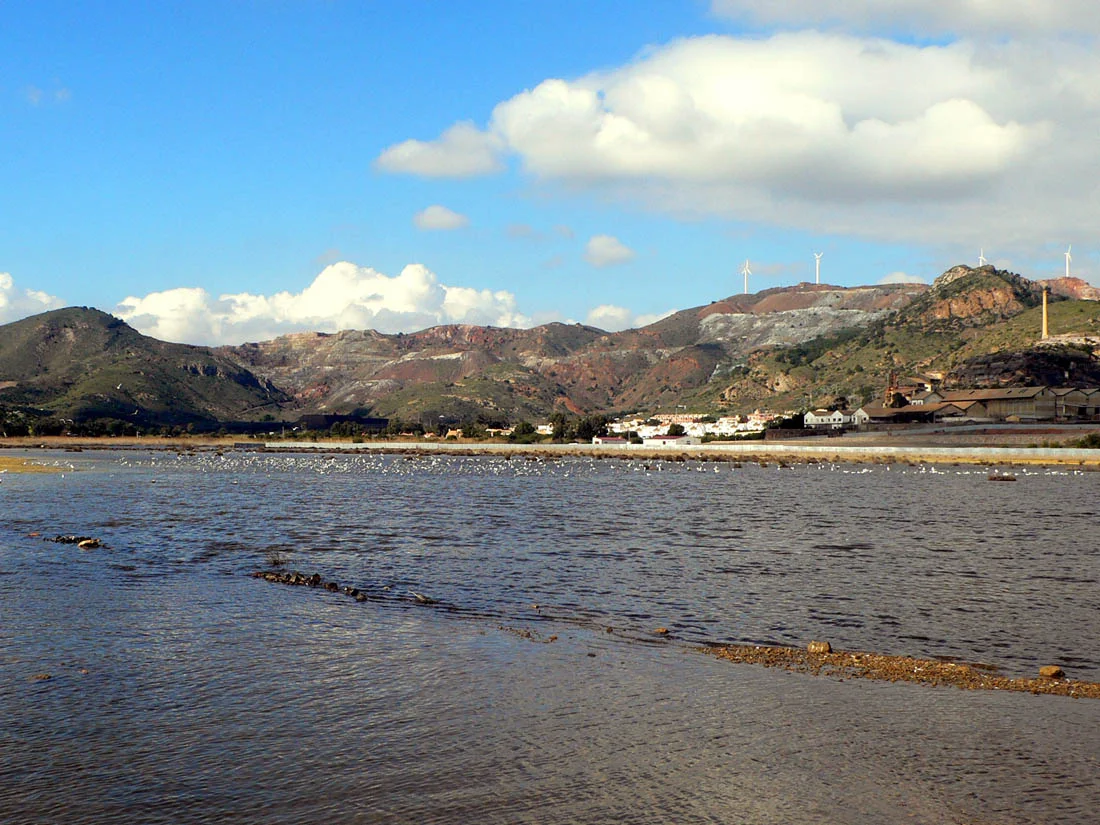

Portmán
The Romans named this place Portus Magnus, the Great Port, for the deep, sheltered water where their ships could load the silver of the mountains behind it. Stand at Portmán today and you will look for that harbor in vain. The bay is gone, filled level with the land by an estimated hundreds of millions of tons of mining waste poured into it across the second half of the 20th century. Where galleys once anchored, there is now a flat, gray expanse of hardened sludge. It is among the most complete environmental transformations anywhere on the Spanish coast, a working harbor erased so thoroughly that its own name has become an epitaph.
Portus Magnus
For two thousand years this bay was defined by what the hills gave up. The Romans built a port here in the first century and worked the surrounding sierra intensively, leaving behind smelting sites and the mosaics of a grand villa now preserved in the La Union archaeological museum, housed right here in Portmán. The name traveled through the centuries, becoming Burtuman al-Kabir in the age of Al-Andalus and Porte Mayn in a 14th-century Castilian hunting book, which described the mountains around it as good winter ground for wild boar. When a new mining boom swept the Sierra Minera in the mid-1800s, Portmán entered a period of real splendor, a town of miners, fishermen, and merchants clustered around a harbor that had served every power to rule this coast.
The Sea Turned to Land
The ruin came from a single decision, repeated for thirty years. Beginning in 1957, the French firm SMM Penarroya-Espana extracted the sierra's pyrites by open-pit methods that were cheap and produced staggering volumes of waste. The ore had to be washed, and the washing left a fluid slurry that was expensive to store on land. The company's answer was to pipe it straight into the Mediterranean. Coastal authorities had twice refused permission, in 1954 and 1957, citing the poison in the discharge and the ruin it would bring to fishing. The bay began to silt up almost at once, and the company's own engineers privately admitted that Portmán as a port was finished. Rather than stop, they set about making the harbor's death official.
A Decision Made in Back Rooms
What followed reads as a case study in how power overrode a community. In 1958 the authorities reversed themselves, permitting the dumping under conditions, a submarine pipeline set well offshore, a five-year limit, compensation for fishermen, that were steadily ignored or quietly loosened. By 1969 every limit on the discharge had been lifted. Penarroya, with ties reaching into Franco's regime and into the tourism boom then remaking the nearby coast at La Manga, arranged to abandon Portmán entirely, trading land for a new port at Cabo de Palos. The mayor of La Union protested that this would mean the death of his town; his letter fell on deaf ears. In 1971 the Supreme Court acknowledged the town's grievance and ruled for the company anyway. Only in 1986, when Greenpeace activists chained themselves to the waste pipes, did the wider world begin to notice.
What the Tailings Left Behind
The dumping finally ended in 1990, and the mines closed soon after, but the poison stayed. The buried bay holds sediments laced with cadmium, lead, and the chemical residues of ore-washing, and studies have traced heavy metals from this ground into the bodies of local people decades later. A regeneration project was approved in 2011, worth some 79 million euros, then stalled almost immediately when the government changed. Work eventually began in 2016, but even the cure is fraught: dredging the toxic sediment risks releasing what it disturbs. Through all of it, Portmán has kept living. Its people still gather for the feast of James the Great in July and the seaside procession of the Virgen del Carmen, and they now look to culture and ecotourism where mining and fishing once sustained them, a town determined to outlast the waste that swallowed its harbor.
From the Air
Portmán sits on the coast of the Sierra Minera at 37.583 degrees N, 0.850 degrees W, east of Cartagena and south of La Union. From the air the site is unmistakable and sobering: a broad, flat wedge of pale mining sediment where a bay should be, backed by the scarred, quarried hills of the Sierra Minera and flanked by the green ridges of the Calblanque Regional Park. A lighthouse stands on the promontory a few kilometers east of the inlet. A viewing altitude of 2,500 to 4,500 feet best reveals the contrast between the filled bay, the mining landscape, and the protected coast nearby. Nearest airports are Region de Murcia International (LEMI), about 30 km northwest, and Alicante-Elche (LEAL), roughly 70 km northeast. Visibility along this coast is generally very good, clearest under the dry southwesterly libeccio.
Nearby Stories
- San Javier (Spain) 4.1 km away
- 2011 Lorca Earthquake 23 km away
- German submarine U-573 31 km away
- German submarine U-602 57 km away
- Villajoyosa 80 km away
- Cabo de Gata-Nijar Natural Park 82 km away
- SM U-39 107 km away
- Battle of Las Navas de Tolosa 197 km away