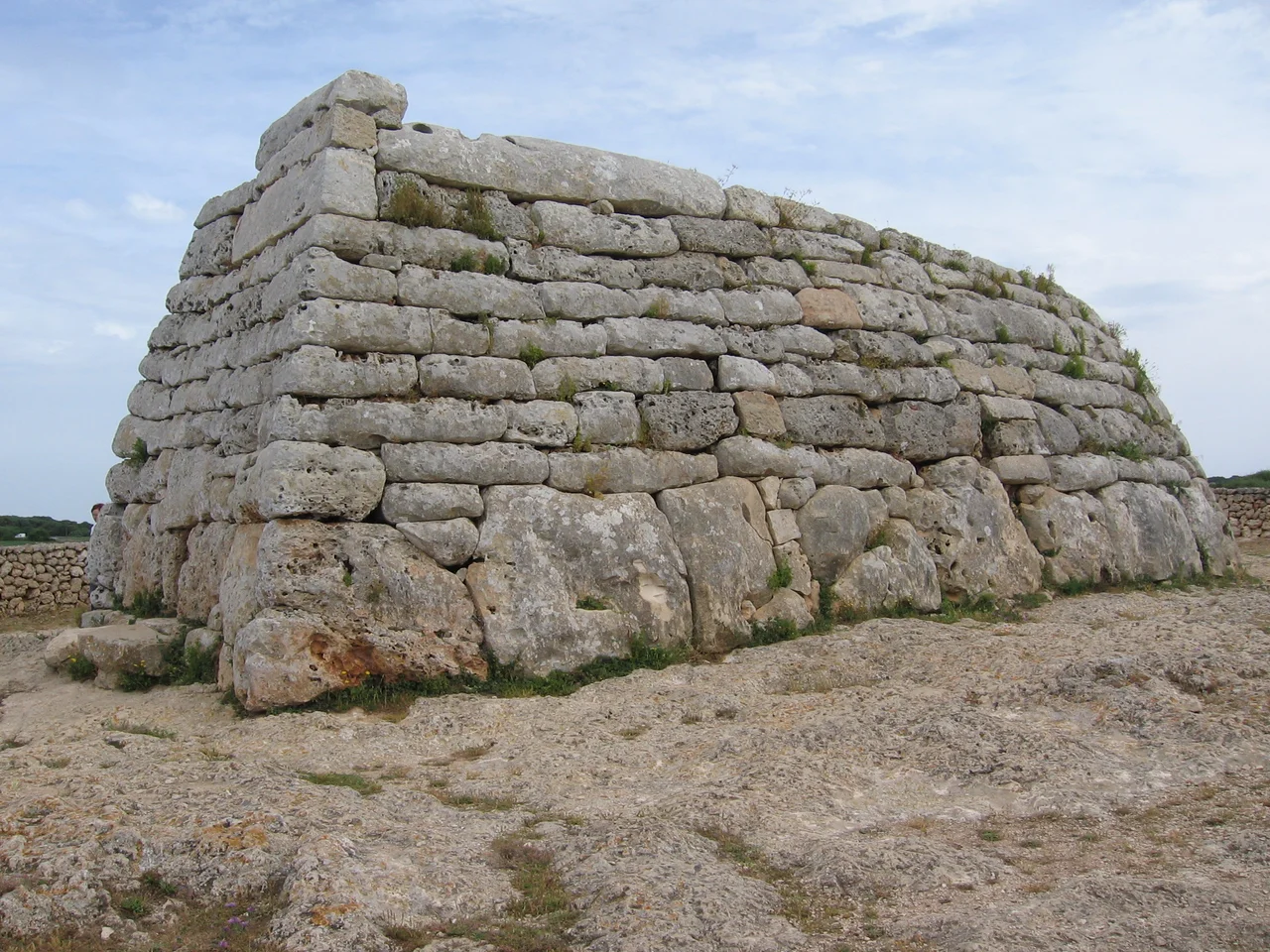

Naveta d'Es Tudons
One stone is missing from the peak of the facade, and for generations the islanders had a story to explain the gap. It involved two jealous giants, a well, and a murder. The truth is stranger in its own way: the Naveta d'Es Tudons is a tomb built to resemble a ship, raised on the western tableland of Menorca more than three thousand years ago. For centuries afterward, Menorcans were so unsettled by these squat stone hulls scattered across their fields that they would not go near them. Today it is the island's most celebrated prehistoric monument.
A Ship for the Dead
The word naveta is a Menorqui diminutive of nau, a ship or nave, and it was the imaginative Dr Juan Ramis who first gave these structures the name, in an 1818 book on the island's antiquities, struck by how much they resembled upturned boats. Es Tudons means the woodpigeons, the name of the place where this one stands, a little south of the road that crosses the island between Ciutadella and Mahon, some three miles out from Ciutadella. There are several dozen navetas across Menorca and neighbouring Majorca, but this is the largest and best preserved of them all, a monument so complete that it has become one of Menorca's essential sights.
Two Chambers, No Mortar
Seen from the side, the naveta really does look like a boat turned over: a flat, trapezoidal stern for its facade, a rounded apse for its bow. It stretches about 14.5 metres long and 6.5 wide, and rises some 4.55 metres, though originally it stood around six. Every block was fitted without a scrap of mortar, held by weight and precision alone. A cramped, low doorway leads through a short passage into an antechamber, and from there into the main lower chamber, roofed by giant horizontal slabs laid across the walls. Above it hides a second, shallower chamber, reached from the top of the antechamber. Two storeys of carefully dressed stone, engineered by people working with nothing but muscle, rope, and an intimate knowledge of rock.
The Ossuary
The two chambers were not idle spaces. The Naveta d'Es Tudons served as a collective ossuary between about 1200 and 750 BC, and the division of levels reflected a deliberate rite. The bodies of the dead were first placed in the upper chamber, where the flesh was allowed to decay; the bones were then gathered and stored in the lower chamber below. Radiocarbon dating of remains from the island's navetas points to use between roughly 1130 and 820 BC, and the finds recovered here are now kept in the Museu de Menorca. During restoration, the two or three courses missing from the top were carefully set back in place. Generation after generation of one community passed through these walls, their bones tended by the living long after death.
The Giants of Es Tudons
The archaeology is remarkable, but the folklore is unforgettable. According to the writer Phil Lee, Menorcans remained wary of these odd, solitary monuments well into the nineteenth century, as though some memory of their purpose lingered. One story in particular clings to Es Tudons. Two giants, it is said, loved the same young woman and agreed on a contest: one would build the naveta, the other would dig a well, and whoever finished first would marry her. Just as the builder reached for his final stone, his rival struck water. Mad with jealousy, the builder hurled that last stone into the well, killing the other giant, then took his own life in remorse. The girl, the tale ends, died a spinster and was buried in the naveta. It explains, at least, the missing stone.
Among Menorca's Navetas
Es Tudons is the star, but it has company. Navetas dot Menorca and neighbouring Majorca by the dozen, some built on a single storey, others, like this one, on two, each a variation on the same idea of a stone ship for the dead. Together with the island's taula sanctuaries and talayots, they form one of the densest concentrations of prehistoric monuments anywhere, a heritage the world acknowledged in 2023 when Talayotic Menorca joined the UNESCO World Heritage List. Es Tudons earns its fame by being the most complete of the navetas, restored where a few upper courses had fallen and now protected, its interior closed to keep it from harm. You can walk right up to it, though, and stand where the woodpigeons gave the place its name, before the earliest of the island's tombs were even a memory.
From the Air
The naveta stands at 40.003°N, 3.892°E, on the western tableland of Menorca, just south of the Me-1 road roughly three miles east of Ciutadella. From 2,000 to 3,500 feet AGL the monument is small but sits in open, gently rising farmland; navigate by the straight Ciutadella-to-Mahon road and the old capital's harbour town on the west coast nearby. Menorca Airport (LEMH) lies about 22 nm east near Mahon; Palma de Mallorca (LEPA) is roughly 90 nm west. Clear, low-angle light picks out the stone-walled fields and the pale bulk of the naveta among them.
Nearby Stories
- Castle of Capdepera 7.5 km away
- Cap de Formentor 26 km away
- Ses Païsses 59 km away
- Llobregat Delta 165 km away
- Somorrostro 200 km away
- Porto Flavia 332 km away
- Cosquer Cave 336 km away
- Nuraghe Seruci 340 km away