
Municipal Archaeological Museum of Cartagena
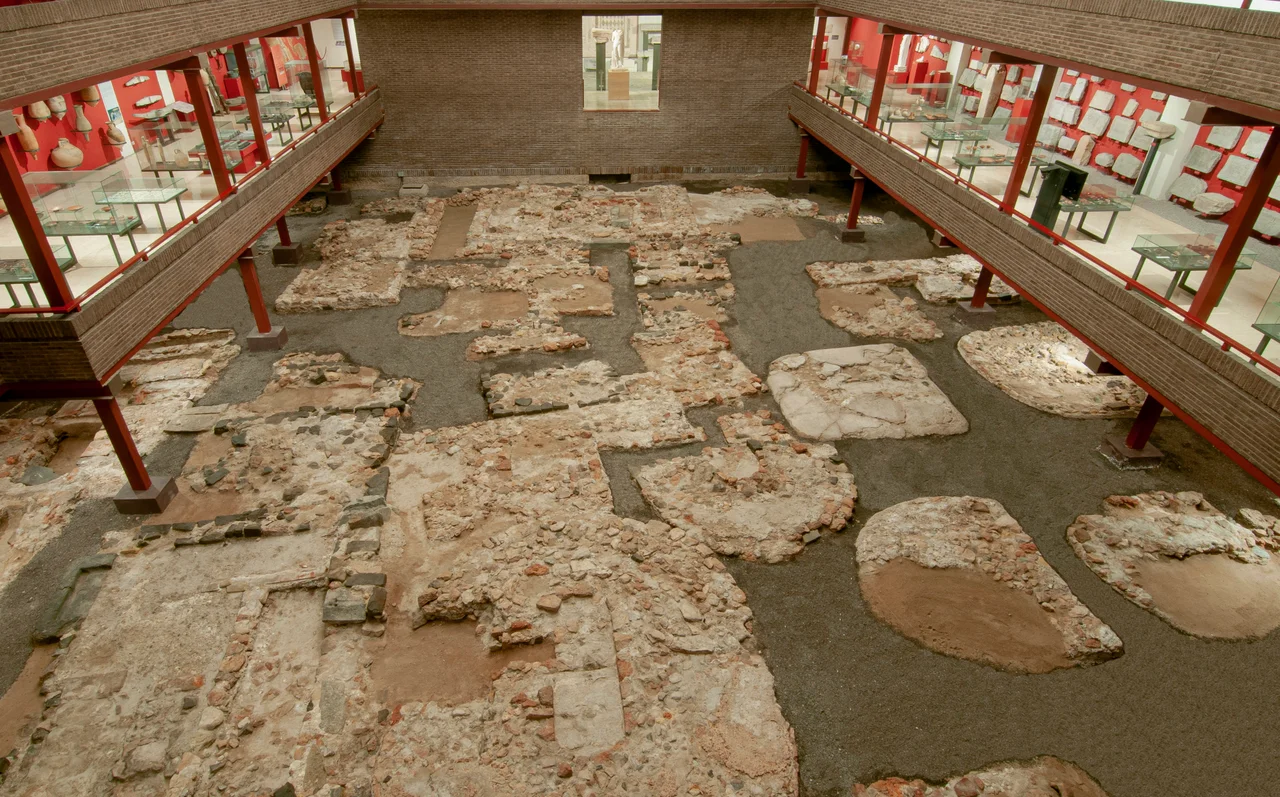
At the center of this museum lies a graveyard. When workers uncovered a Roman burial ground in 1967, the easy thing would have been to catalogue the bones, box up the grave goods, and pour concrete over the rest. Cartagena did the opposite. It chose to build the museum around the necropolis, leaving the tombs where the ancients had placed them, so that today the galleries wrap around the dead and visitors look down on them from the exhibition route. It is a fitting arrangement for a city that has never really stopped living on top of its own history.
A Museum Around a Grave
The San Anton Necropolis surfaced during construction in 1967, and the museum's director, Pedro San Martin, saw at once what it demanded. Instead of relocating the find, he proposed to the city council that a new museum be raised around the site itself, preserving the graves in place. It was an ambitious idea, and an expensive one. The council acquired the land and paid to adapt the building, but the work dragged, and the museum did not open its new home until 1982, years behind schedule. The wait bought something no ordinary display case can offer: the necropolis remains the beating heart of the institution, visible from point after point along the galleries, the artifacts of the living arranged in orbit around the resting place of the dead.
From a Society of Friends
The collection is far older than the building. Cartagena has guarded a set of Roman inscriptions since the late 16th century, and in the 1800s the Royal Economic Society of Friends of the Country began gathering antiquities in earnest, much of it drawn from the mineral-rich mining district of Cartagena and La Union. That effort produced a Mineralogical and Antiquities Museum in 1883, the seed from which the modern institution grew. The Municipal Archaeological Museum itself was formally founded on the 25th of October 1943 under its first director, the archaeologist Antonio Beltran Martinez, opening in humble quarters before its collections outgrew one home after another.
The Layers of Carthago Nova
Beneath Cartagena lies Carthago Nova, the New Carthage that Rome seized in the Second Punic War, and the museum's holdings reflect that depth. The exhibits run from the Middle Paleolithic all the way to modern times, but it is the Roman city that dominates, as it dominates the ground underfoot. The galleries are organized to teach: artifacts arranged chronologically on one floor, then grouped by site and excavation on the next, with the necropolis visible throughout. Among the treasures are a celebrated collection of Latin epigraphy, the carved inscriptions through which the Romans recorded their lives and deaths, an Iberian wine-jug, and a delicate Hellenistic earring from the second century BC, recovered from the city's Roman amphitheater. Because excavation never stops in the historic center, the collection keeps growing, fed by discoveries made whenever the modern city digs into its ancient foundations. Every new building project is also, potentially, a new dig.
A Working Institution
This is not a mausoleum of dusty cases but a working research center, and part of the wider Regional Network of Museums of Murcia. The museum houses libraries, workshops, and photographic and restoration laboratories where new finds are cleaned, studied, and stabilized before they ever reach a display. Its collection traces its own long lineage back to the Mineralogical and Antiquities Museum of 1883 and, further still, to the Roman inscriptions the city has guarded since the 1500s. Once a year, during the Night of Museums, the doors open free to all, and the people of Cartagena come to stand above the necropolis their forebears chose to preserve. Few museums so plainly embody their own mission. Here the act of remembering and the thing remembered occupy the same walls, the past kept exactly where it was found.
From the Air
The museum sits inland in Cartagena at 37.615 degrees N, 0.993 degrees W, a short distance north of the harbor front. From the air, orient on the deep, fortress-ringed bay of Cartagena and its old town, with the Roman theater and Concepcion Castle hill marking the historic core just to the south. A viewing altitude of 2,000 to 3,500 feet gives the clearest read of the city's compact street grid. Nearest airports are Region de Murcia International (LEMI), about 35 km northwest, and Alicante-Elche (LEAL), roughly 75 km northeast. The coastal light is usually crisp, with the best visibility over the old town in the morning before the afternoon haze settles in.
Nearby Stories
- San Javier (Spain) 4.1 km away
- 2011 Lorca Earthquake 23 km away
- German submarine U-573 31 km away
- German submarine U-602 57 km away
- Villajoyosa 80 km away
- Cabo de Gata-Nijar Natural Park 82 km away
- SM U-39 107 km away
- Battle of Las Navas de Tolosa 197 km away