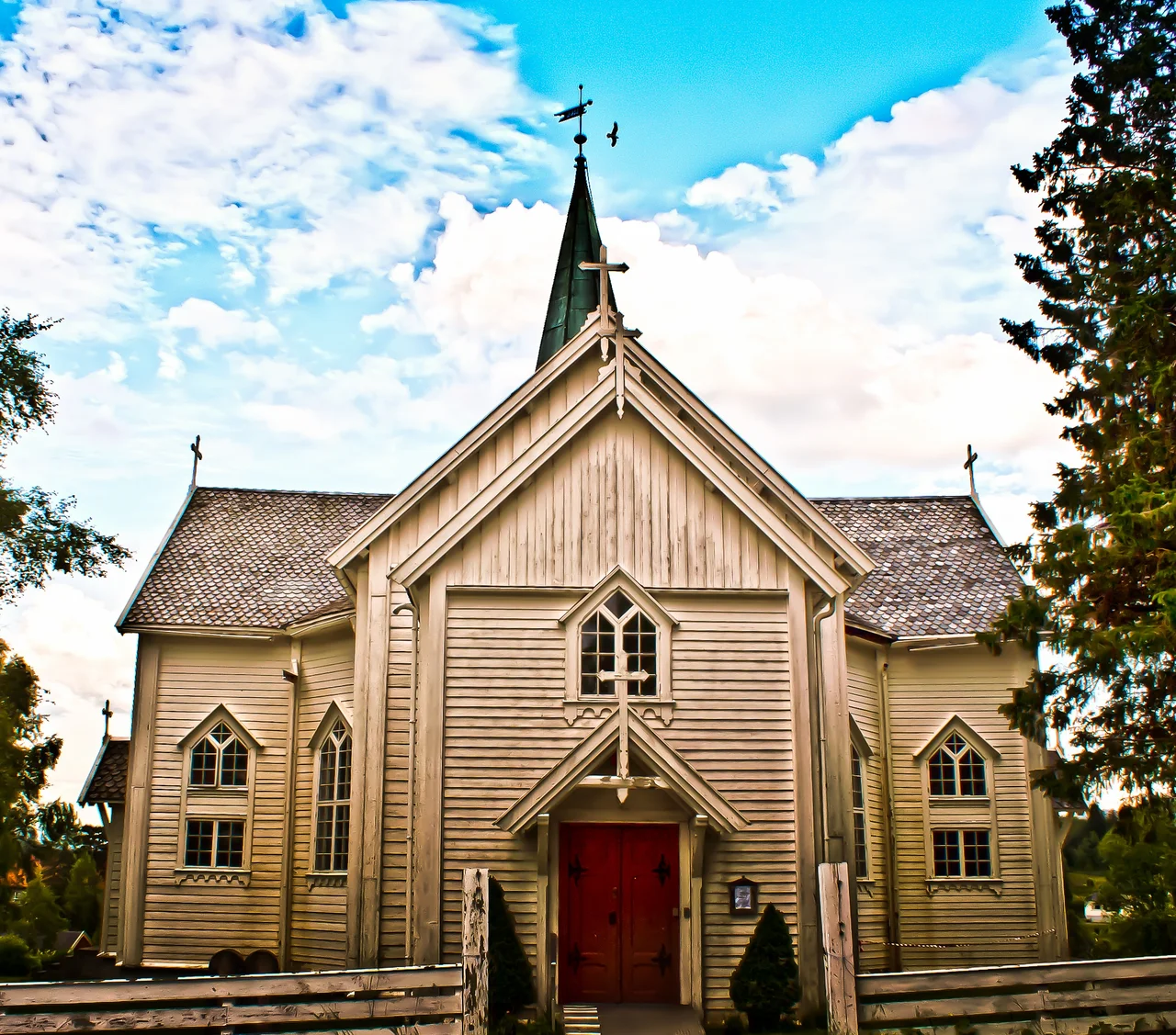

Leirfjord Church
The church was built twice. The first time was somewhere inland — in Grane, or in Namdalen, where the good timber grew and where a master builder named Listad worked. There the logs were hewn, notched and fitted together into the shape of a cross, checked for accuracy, and then deliberately taken apart. The numbered pieces travelled down to the coast and across the water to Leirfjorden, where they were assembled a second time on a grey-stone foundation beside the Leland farm. Anyone who has watched a timber frame go up knows how much depends on the joints being cut right the first time. Whoever did this got it right across a mountain range and a fjord, with no chance to adjust once the load was on the boat.
Eckhoff's Nordland Years
The plans came from Niels Stockfleth Darre Eckhoff, who lived from 1831 to 1914 and spent the years from 1862 to 1866 working in Nordland. Leirfjord Church, consecrated on 27 August 1867, belongs to the tail of that northern stint, alongside his churches at Nesna and Nordvik. Eckhoff had trained under Johan Henrik Nebelong and worked across a career that ran from historicism into neo-Gothic and eventually Art Nouveau; after Nordland he laid out Christiania neighbourhoods with Georg Andreas Bull and designed a city hall and a bank in Drammen. The Leirfjord commission is a coastal parish church rather than a monument, but it carries a designer's trick worth noticing. The plan is a cross whose inner corners are cut off — brutte hjørner, broken corners — so that the four arms open into an octagonal room at the centre. It seats about 450.
Measured in Alen
The dimensions were written down in the old Norwegian ell: the eastern arm eleven alen long and twelve wide, the other three arms five alen long and twelve wide. Each transept has its own entrance door, which in a scattered coastal parish is practical rather than decorative — congregations arriving from different directions come in where they land. The walls are laftet tømmer, horizontal notched logs, on the grey-stone base. It is a big building for the district, and a plain one: the ambition went into the geometry and the joinery rather than into ornament.
The Graveyard Came First
There had never been a church in Leirfjord before 1867. The churchyard, however, was already in use — consecrated ground was established years ahead of any building to stand beside it, which tells you which of a parish's needs is the more urgent. For its first stretch of life the new church was a hjelpekirke, an auxiliary church, subordinate to Stamnes Church over at Sandnessjøen. It has since become the main church for the Leirfjord parish, part of the Nord-Helgeland deanery in the Diocese of Sør-Hålogaland. Leland, where it stands, is now the administrative centre of Leirfjord Municipality, on the mainland shore of the fjord that gives both the municipality and the church their name.
Frost, and a Thirteen-Year Delay
Ground that freezes moves, and ground that moves takes buildings with it. Over decades the frost worked at the foundation, opening structural damage, while a leak developed along one of the chimneys and the tower quietly rotted. Restoration was scheduled for 1937. Then Germany occupied Norway, and the work did not begin until 1950, five years after the war ended and thirteen years after somebody first drew up the plan for it. The repair, when it finally came, was thorough. The foundation was carried deeper, below the frost line. A cellar was excavated and the floor replaced and insulated from underneath. New chimneys were built outside the walls rather than through them. The tower was replaced outright. The bill came to somewhere near 150,000 kroner — a serious sum for a rural parish in the first years after the occupation, and the price of keeping a travelling church standing where it had landed eighty-three years earlier.
From the Air
Leirfjord Church stands at 66.062°N, 12.938°E in the village of Leland, on the eastern shore of the Leirfjorden in Nordland — about 55 km south of the Arctic Circle. It is a wooden cruciform church, low and broad rather than tall, best identified from 1,500–3,000 feet AGL on a north–south run along the fjord shoreline. The Helgeland Bridge and the Seven Sisters ridge on Alsta lie about 10 km west across the water, giving an easy visual fix. Sandnessjøen Airport, Stokka (ENST) is roughly 25 km west-southwest; Mosjøen Airport, Kjærstad (ENMS) roughly 35 km southeast. Expect maritime Nordland weather: low ceilings, frequent rain and snow squalls off the Atlantic, strong winds funnelled along the fjord, and very short daylight around midwinter.
Nearby Stories
- Lukttinden 8.5 km away
- Grane Church 18 km away
- Lomsdal–Visten National Park 19 km away
- Vega 22 km away
- Træna Lighthouse 23 km away
- Bremstein Lighthouse 65 km away
- Operation Musketoon 65 km away
- Dunderland Valley Bus Crash 90 km away