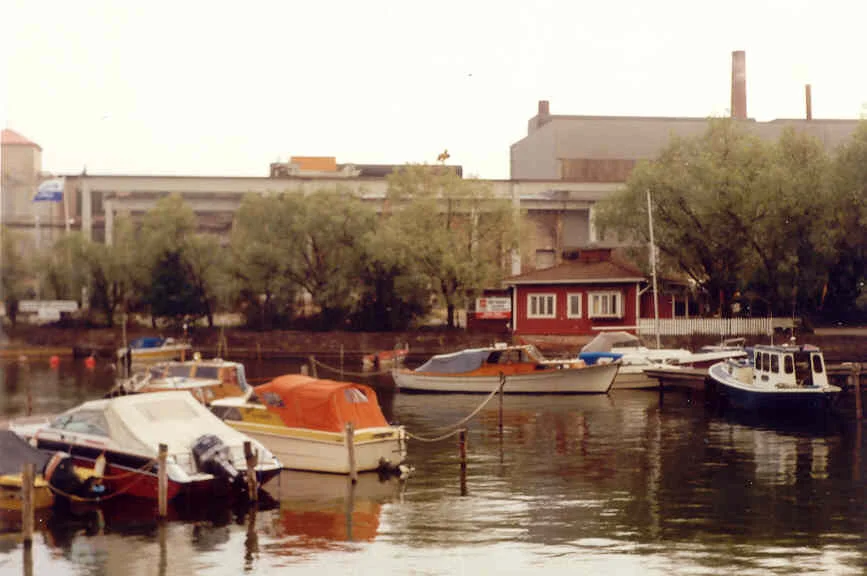

Dalsbruk
Put your hand on a wall in Dalsbruk and there is a fair chance you are touching furnace waste. Many of the village's buildings are made wholly or partly from slag brick — blocks pressed from the by-product of iron smelting — so the houses here are quite literally built out of what the ironworks could not sell. That is the shortest possible description of this place on the southern tip of Kimitoön, in the Finnish archipelago: for 326 years it made iron, and everything else about it, including the walls, followed from that.
Deep Harbour, Deep Forest
In 1686 a Swede named Daniel Faxell, later ennobled as Cronmarck, chose the village of Dahls for an ironworks. The land belonged to the Crown and held only a handful of peasant families, but it had the three things a seventeenth-century furnace needed and could not do without: a good deep harbour for bringing in ore and shipping out iron, forest enough to burn into charcoal for generations, and falling water to work the bellows and hammers. The first blast furnace was blown in 1688. Ownership then moved through a long line of merchants and gentry — Mikael Hising, who bought the works in 1724 and repaired the decaying furnace; the Petersen family; Wolter af Petersén; Carl August Ramsay from 1834, then Wolter Ramsay; and finally Oy Wärtsilä Ab in 1937–38. Dalsbruk's blast furnace is among the oldest in Finland.
The Furnace That Moved to an Island
Walk below the old stone dam and you are standing in the original works. The grey-stone and brick blast furnace survives as a ruin, and around it lie the foundations of the roasting house, the sintering furnace and the charcoal room. The ruin you see is a nineteenth-century rebuild that stayed in service until 1928. South of it stand the slag-brick and red-brick buildings that came later — the foundry, the brick machine shop, the screw and bolt factory. But by the late nineteenth century the centre of gravity had shifted offshore to Skeppsholmen, once merely the loading quay for cargo ships. A rolling mill went up there around 1860, then puddling furnaces, then steam-powered bar-iron hammers, and in 1879 Finland's first Siemens-Martin open-hearth furnace. By the twentieth century every industrial operation had crossed to the island, cutting the plant loose from the village that served it.
One Room, Whole Families
The company owned most of the land, wrote the zoning and put up the buildings, and the buildings tell you what the wage was really worth. Well into the twentieth century more than sixty per cent of workers' homes consisted of a single room; another third were one room plus a kitchen. Overcrowding was simply the condition of life, easing only in the 1920s as two-room flats spread, and housing shortages never fully went away. Slottet held apartments for twenty-eight families. In the 1890s the works pushed west onto Sabbels Hill with long gallery-corridor barracks whose tall blank façades face the sea while the decorated side — the entrances, the balconies — turns inward to a sheltered courtyard, an arrangement that says a good deal about where domestic life actually happened. And the residents named the buildings themselves. Slottet is the Castle. The pale barracks on the slope, built in 1902, is Koirankoppi, the Doghouse. The cluster of small 1920s and 1930s houses on slag-stone foundations, standing apart like their own little archipelago, is Honolulu. Naming a company barracks after a tropical island is not sentiment. It is people claiming a place the company owned on paper.
1937 to 2012
Under Wärtsilä the works became a major regional employer, and after the Second World War much of its output went east to the Soviet Union as war reparations. Employment peaked near twelve hundred by the mid-1970s. Then the steel crisis of the early 1980s arrived, and the long contraction began. The end came suddenly. In mid-2012 the Dutch-owned FNsteel declared bankruptcy and shut both its Finnish mills — Dalsbruk and Koverhar in nearby Hanko — which between them had produced wire rod and prestressing strand. Nearly four hundred people in an already strained region lost their work, and employees and local authorities alike were caught completely off guard. Prosecutors later charged former board members with concealing some thirty-five million euros in assets ahead of the filing, alleging that products had been shuffled to other subsidiaries for no business reason. Iron had been made here since 1688. It stopped over a summer, in a courtroom argument about where the money went.
Jazz in the Furnace Ruins
About a thousand people still live here, in a village that the Finnish Heritage Agency has designated a nationally significant built cultural environment — industrial buildings, warehouses and workers' housing spanning the eighteenth century to the present, standing together in a coherence you rarely get outside a company town. The Dalsbruk Ironworks Museum opened its first permanent exhibition in 1983 and now covers six buildings and eleven charcoal kilns; in the Norrbacka cabins the rooms are furnished to show how workers lived between 1890 and 1960, which is the most honest exhibit in the place. The blast-furnace ruins have become a venue: concerts during the Baltic Jazz and Norpas festivals, and in the summer of 2013 open-air theatre. In June runners cross the Lövö bridge toward Kasnäs in the Lövö broloppet half marathon. Since 2009 Dalsbruk has been part of Kemiönsaari, its old municipality of Dragsfjärd folded into the merger. The furnace is cold. The village kept going.
From the Air
Dalsbruk lies at 60.02°N, 22.51°E on the southern end of Kimitoön (Kemiönsaari), the large island at the eastern edge of the Archipelago Sea. Best viewed from 1,500–3,000 ft AGL. From the air the layout is legible in one pass: the sheltered harbour inlet, the industrial island of Skeppsholmen set slightly apart from the shore, the stone dam and furnace ruins inland of it, and the housing rows climbing the low hills west and north. Beyond the village the archipelago breaks into thousands of skerries toward Kasnäs and the Lövö bridge to the southwest. Nearby airports: Turku (EFTU) 65 km north, Helsinki-Vantaa (EFHK) 145 km east-northeast, Kiikala (EFIK) 55 km northeast, Hanko (EFHN) 60 km east across the Gulf. Archipelago flying rewards caution — sea fog forms fast in spring and early summer when warm air crosses cold water, and horizon definition over open water in overcast conditions can be poor. Winter ice changes the whole appearance of the coastline, welding the islands to the mainland in a single white plane.
Nearby Stories
- Sauvo 5.7 km away
- Ekenäs Church 14 km away
- Russian cruiser Pallada (1906) 19 km away
- Archipelago National Park 20 km away
- Nådendal Abbey 21 km away
- Paikkari Croft 34 km away
- Sinking of the MS Estonia 50 km away
- Neugrund crater 51 km away