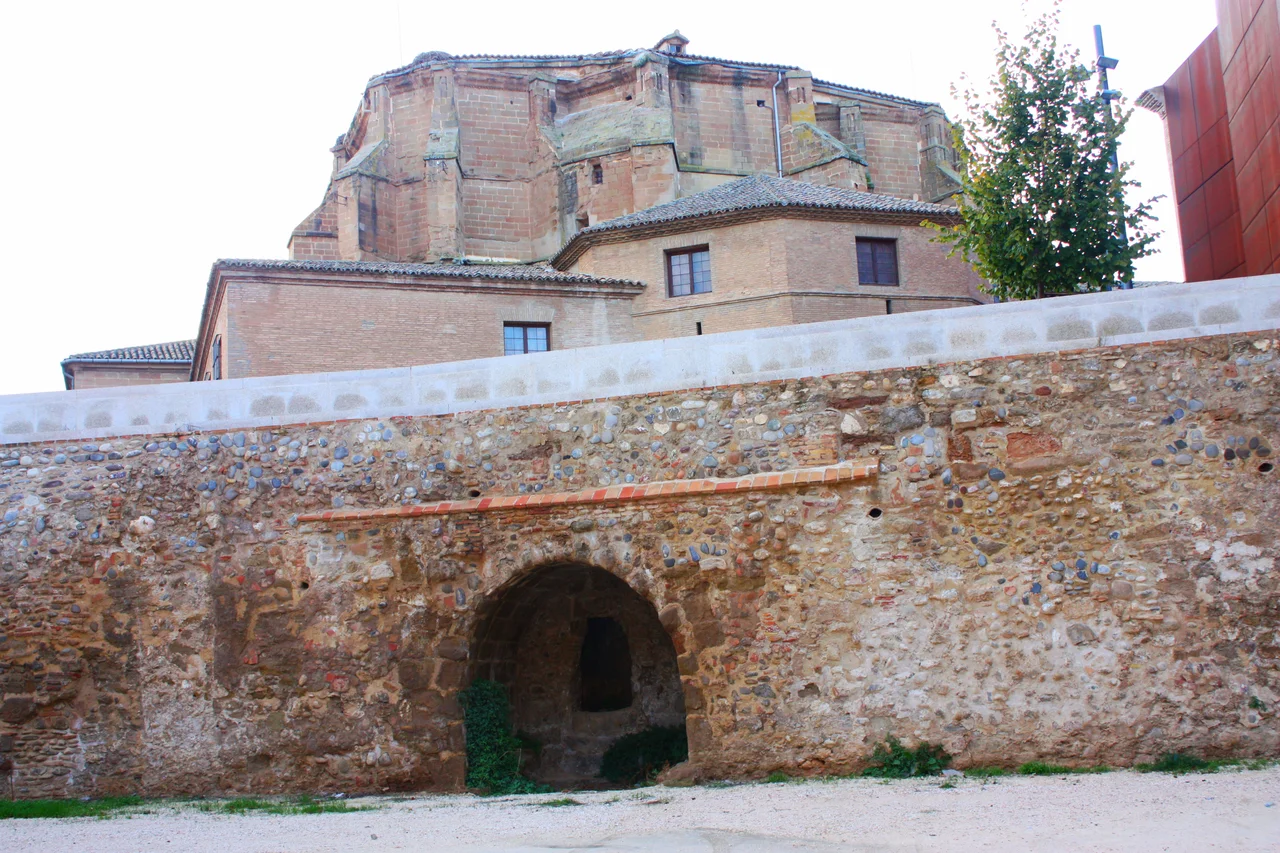

Barbastro
Look up at the bell tower of Barbastro's cathedral and you are looking at two towers at once. The outer shell is Christian and hexagonal, raised in 1610. Sealed inside it stands something older and stranger: the narrow minaret of the mosque that occupied this ground before the cathedral, its inner stones still scorched black. The burn marks have a date. In 1366, when the mercenary captain Bertrand du Guesclin passed through and sacked the town, 306 people carried their belongings up into the tower to hide. The soldiers set it alight, and none came out. Over the centuries the same tower has served as minaret, belfry, jail, hideout for a secret society, and an anti-aircraft post. Even now, an old air-raid siren sounds from it at noon.
Four Walls and a Thousand Years
Barbastro is a town that kept building rings around itself. It began as a Celtiberian settlement, became Roman Brutina, then passed to the Visigoths before Muslim forces took the Barbitaniya district in 717. The first fortress crowned the Barbacana hill in 811; a second wall went up in 918 to protect the growing town; a third followed under King Juan I at the close of the 14th century; a fourth enclosed the southern orchards in the 1600s. Each ring survives in fragments, leaning behind newer buildings or supporting the floors of a former hospital. The Christian conquest came in fits and starts. Frankish knights under William VIII of Aquitaine stormed the city in 1064, only for it to fall back to the Moors a year later. Not until 1101 did Peter I of Aragon take it for good and make it a bishop's seat.
A Village Inside the City
Behind the cathedral lies the Entremuro, the oldest quarter, so quiet it feels like a village that a city grew around. Enter down the dark, narrow Hornos street and you pass a wall of alternating brick and stone that locals still call the Roman wall, though it was built that way simply to save money. Almost every house here keeps a small orchard at the back, a survival of the Muslim city plan; residents call these gardens carmenes, from the Arabic karm, the same word and the same pattern you find in Granada's Albaicin. Into the 1980s, families still kept mules and donkeys on the ground floors. At a corner of the Esperanza and Pena streets once stood the town's synagogue, converted under duress to a shrine, where the Jewish community is said to have kept its rituals in secret.
Where a Kingdom Was Joined
The Entremuro climb ends at Candelaria Square, a modest space with an outsized place in Spanish history. Here Petronila, the only daughter of King Ramiro II of Aragon, was betrothed to the Count of Barcelona, binding Aragon and Catalonia under a single crown. Their son would rule a realm that eventually reached from the Balearic Islands to Sicily, Naples, and Athens. One house on the square still carries a papal coat of arms carved in stone, marking the lodging reserved for the Pope's representatives when the king held court in Barbastro. It is a strange thing to stand in a small provincial plaza and realize that the map of the medieval Mediterranean shifted, in part, on a marriage arranged on this exact patch of ground.
The River and the Table
Barbastro sits where the Vero meets the Cinca, and the Vero once ran right against the backs of the houses. Before the river was walled in concrete to stop its violent floods, those buildings dropped sheer into the water. George Orwell, passing through during the Spanish Civil War, remarked on the sight. Today you can walk the far bank and look back at the colored facades, or descend to the old ice well, a dark cave where winter ice was stored for summer. The town has always lived by trade with the Pyrenean valleys, and it eats accordingly. The local specialty is chiretas, lamb stomach stuffed with spiced rice and meat, a close cousin of Scottish haggis, washed down with the robust red wines of the surrounding Somontano country.
From the Air
Barbastro lies at 42.037 N, 0.127 E, in the Somontano lowlands of Huesca province where the Cinca and Vero rivers meet, with the Pyrenees rising to the north. Best viewed from around 4,000-6,000 feet AGL; the compact old town and its detached hexagonal cathedral tower are the key visual landmarks, with the wooded Coso avenue cutting through the newer districts. Nearest airfield is Lleida-Alguaire (LEDA) to the southeast; Reus (LERS) and Barcelona-El Prat (LEBL) lie further east. Clear, dry continental air gives excellent visibility across the plain to the mountains.
Nearby Stories
- Montsec Range 8.1 km away
- Palauet de la muralla de Balaguer 10 km away
- Catalan Romanesque Churches of the Vall de Boi 18 km away
- Battle of Almenar (1082) 33 km away
- Castle of Loarre 33 km away
- Ordesa y Monte Perdido National Park 36 km away
- Zaragoza Barracks Bombing 47 km away
- Palace of the Kings of Navarre of Olite 107 km away