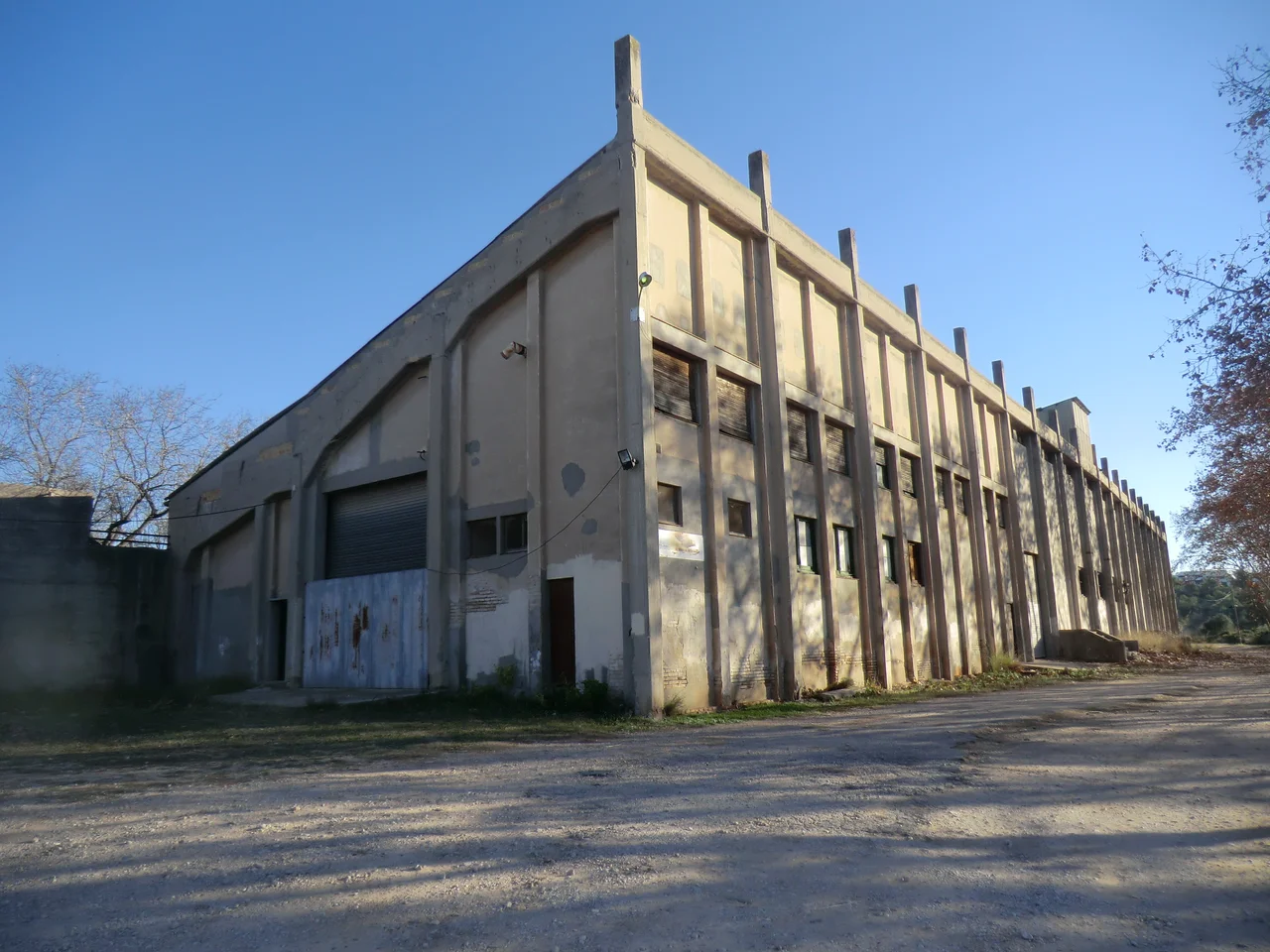

Autódromo de Sitges-Terramar
For most of the past hundred years, one of the world's first purpose-built racetracks was known chiefly to a flock of chickens. The Autòdrom de Sitges-Terramar, a steeply banked concrete oval in the hills of Sant Pere de Ribes near Sitges, was raised in a burst of ambition in 1923 and abandoned almost as quickly. It ran one glorious season, went spectacularly broke, and then settled into a long, strange afterlife as farmland, film set and ghost. The banking is still there, curving up toward the Mediterranean sky, a monument to how fast a dream can be built and how fast it can fall apart.
Three Hundred Days
When Terramar was conceived, the idea of a track built solely for racing was still a novelty. Europe had only two, Brooklands in England and Monza in Italy; the United States had Indianapolis. Terramar joined that tiny company, and it did so at astonishing speed. The whole circuit, a high-speed oval with sharply raked banking at each end, went from bare ground to finished venue in just three hundred days. Speed of construction, it would turn out, was both the track's proudest boast and the root of its undoing, because the money to pay for all that haste was never fully there.
One Glorious Afternoon
The inauguration came on 28 October 1923. Rain fell hard all day, yet thousands still made their way out to Sitges and the circuit, and the infante Alfonso de Borbón, Prince of Asturias, attended on behalf of the royal household. Then the racing began. The French driver Albert Divo took the first Spanish Grand Prix at the wheel of a Sunbeam, completing the course in two hours, forty-eight minutes and five seconds at an average speed of around 142 kilometres per hour, a giddy pace for the era. Divo was showered with prizes, five cups in all, among them the King's Cup and the Italian Ambassador's Cup. Motorcycle races followed over the next days. For one weekend, Terramar looked like the future.
The Money Ran Out
The reckoning arrived almost immediately. The construction company had never raised enough capital to cover the cost of the rushed build, and with the bills unpaid, the builders simply seized the gate receipts. That left the organizers with nothing to pay the drivers who had just raced. The consequence was severe and lasting: Terramar was barred from ever hosting international races again. The drivers had grievances of their own, complaining that the transition from the straights into the steep banking and back out again was awkwardly designed and unsettling at speed. Smaller clubs kept a trickle of events going through the later 1920s. A motorcycle championship in May 1925 drew King Alfonso XIII and the dictator Miguel Primo de Rivera, and that same year the Penya Rhin club used the track to present a Bugatti to the Spanish public for the first time. But the crowds and the prestige never returned in force, and the circuit's brief life as a world venue was already over.
Chickens, Ghosts and Film Crews
What followed was decline by degrees. The state seized the estate in 1929; a Czechoslovak racer, Edgar de Morawitz, took it over the next year and even ran a piston factory inside the enclosure. The Spanish Civil War stopped everything, and during the conflict the site served as a military recruitment centre. Afterward the interior of the oval was given over to poultry farms, and heavy trucks hauling feed and birds chewed at the old surface for decades. A chicken farm operates there still. Yet the banking never lost its pull. A Canadian, Peter Schomer, rediscovered it in the 1990s; car brands returned to shoot advertisements; in 2012 Carlos Sainz set a lap in an Audi R8 LMS for a Red Bull film. In 2018 the presenters of The Grand Tour drove its terrifying slope and dissolved into a fit of swearing and squeaks. A restoration plan that would have blended equestrian events with historic motorsport once promised to wake the old oval again, but Catalonia's high court blocked the project in 2024 and rejected further appeals in late 2025, leaving Terramar's revival, once more, in doubt.
From the Air
The circuit sits at 41.2383 N, 1.7806 E, in the hills of Sant Pere de Ribes just inland from the coastal resort of Sitges, at the foot of the Garraf massif. From 2,500-4,000 ft AGL the distinctive banked oval reads clearly against the surrounding farmland, with the whitewashed seafront of Sitges and the Mediterranean immediately to the southeast. Barcelona-El Prat (LEBL) lies about 30 km to the northeast along the coast; Sabadell (LELL) is inland to the north, and Girona (LEGE) farther up the Costa Brava. Clear coastal light and low terrain make the site easy to pick out on fine days.
Nearby Stories
- Terrassa Witch Trials 11 km away
- Josep Maria Jujol 12 km away
- Cervera 23 km away
- Vandellòs I nuclear incident 45 km away
- El Celler de Can Roca 64 km away
- Battle of Ebro River 94 km away
- Fageda d'en Jordà 103 km away
- Sa Calobra 126 km away