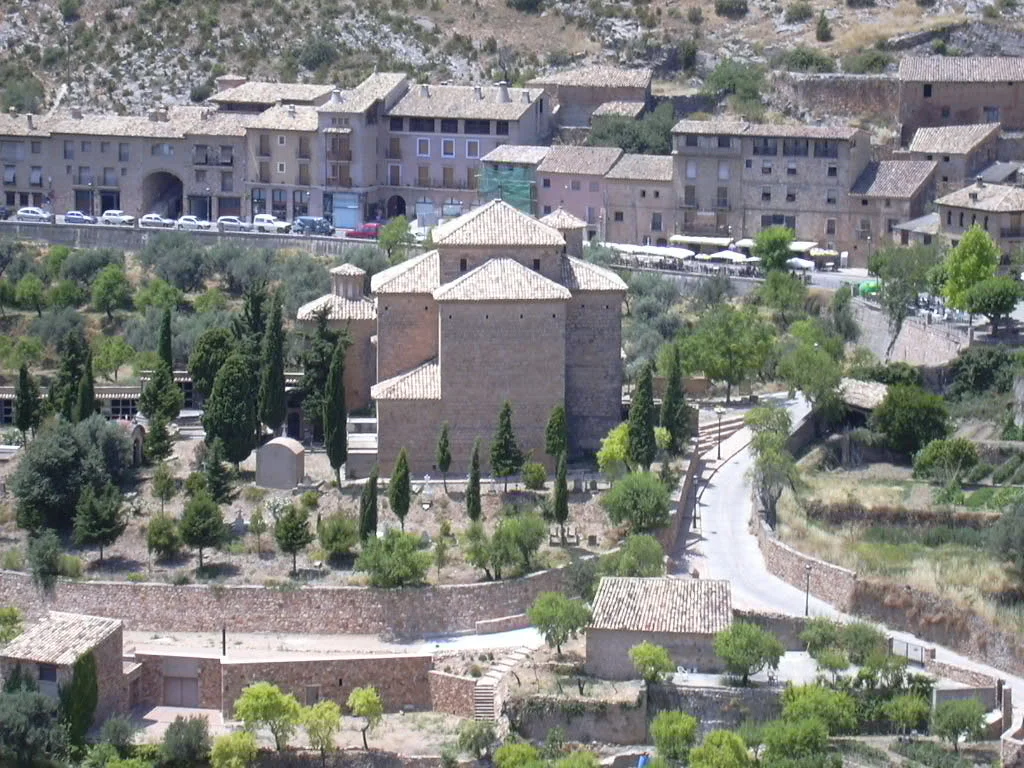

Alquezar
Vultures ride the updrafts off the cliffs of the Rio Vero, wheeling above a village that seems to grow straight out of the rock. This is Alquezar, a town of barely 300 people perched on a limestone spur in the Sierra y Canones de Guara Natural Park, in the north of Aragon. Visitors sometimes say it resembles the Poble Espanyol, the model Spanish village in Barcelona, except that here the medieval streets and stonework are the genuine article, worn by nearly a thousand years rather than built to look old. The setting is half the story: a canyon at its feet, a ruined castle at its crown, and the raw limestone country of the Guara mountains spreading in every direction.
A Village on the Rock
Alquezar sits on an outcrop of Eocene limestone to the west of the Rio Vero's canyon, and its buildings climb the stone in a tight medieval tangle. The village grew up around two things: a castle and the Collegiate church of Santa Maria, which was consecrated in 1099. Today almost no one here farms; the town lives entirely on the travelers who come for the rock, the water, and the views, filling its square with day-trippers who tour the Collegiata, eat in the central plaza, and drift back to their buses. On weekdays the visitors are mostly French, with a scattering of Belgians, Dutch, and Italians, drawn to a place that has turned its own antiquity into its livelihood.
The Fort in the Name
The village wears its history in its very name. Alquezar comes from the Arabic al-qasr, meaning fort or castle, which Spanish later reshaped into Alcazar. That name points back to the town's origins as a stronghold, the castle serving as the main defensive point for the nearby city of Barbastro on the frontier between Muslim and Christian Spain. Perched where it is, commanding the canyon and the approaches, Alquezar was built to watch and to hold, and the fortified church and castle on its summit still give the silhouette the look of a place that once expected trouble to come up the valley.
Canyon Country
For today's visitors, Alquezar is above all a base camp for the outdoors, and it is the main starting point for canyoning in all of Aragon. The Rio Vero has spent ages carving its gorge through the soft limestone, and the result is a playground of narrow slots, plunge pools, and drops that draws canyoners from across Europe into the heart of the Guara. Operators send adventurers down into the surrounding gorges, while others come for via ferrata, rock climbing, abseiling, or simply the walking trails that follow the Rio Vero through its canyon. The cliffs are a naturalist's draw as well. Vultures nest on the steep canyon faces, and in winter birdwatchers scan the same walls for wallcreepers, the small, flitting cliff-dwellers that give the cold months their own reason to visit. It is beginner-friendly country too, gentle enough for families and older travelers who want the scenery without the extremes.
Old Stones, Older Paintings
The deepest history here is painted, not built. The country around Alquezar holds more than sixty limestone caves marked with prehistoric rock art, a concentration so significant that UNESCO named it a World Heritage Site in 1998. A well-known example lies at the cave of Arpan, north along the road toward Barcabo, where ancient hands left their images on the rock long before any fort or church rose above the canyon. To the south, toward Barbastro and the flatter Ebro basin, the land becomes the Somontano, a region known for its fine wines under the Somontano label. The local table leans on the mountains: stewed rabbit, partridge, and veal in the restaurants, sheep's-milk cheese from the nearby village of Radiquero, honey and olive oil from the valleys. It is a small place with no doctor of its own, sending anyone who needs one down to Barbastro, but for a village of 300 on a rock, Alquezar carries an outsized share of Aragon's wild beauty.
From the Air
Alquezar lies at 42.17 N, 0.03 E on a limestone spur above the Rio Vero canyon, in the Sierra y Canones de Guara in northern Aragon. From the air the village stands out sharply on its outcrop, the Collegiate church and castle crowning the rock with the deep gorge cutting alongside; the pale limestone escarpments of the Guara sierra rise to the north toward the Pyrenees. Of the region's fields, Lleida-Alguaire (LEDA) is the nearest, roughly 90 km south across the plain; Reus (LERS) and Barcelona (LEBL) are considerably farther southeast and east. The terrain is mountainous, generating strong afternoon thermals and, at times, cloud build-up over the peaks, so morning offers the steadiest air and clearest views from around 4,000 to 6,000 feet.
Nearby Stories
- Montsec Range 8.1 km away
- Palauet de la muralla de Balaguer 10 km away
- Catalan Romanesque Churches of the Vall de Boi 18 km away
- Battle of Almenar (1082) 33 km away
- Castle of Loarre 33 km away
- Ordesa y Monte Perdido National Park 36 km away
- Zaragoza Barracks Bombing 47 km away
- Palace of the Kings of Navarre of Olite 107 km away